Built to Outlast: The Architectural and Intellectual Logic Behind Eastern Europe's Enduring Fortress Libraries
When the Walls Were the Strategy
In the popular American imagination, a library is a place of quiet access—a building optimized for retrieval, comfort, and circulation. The medieval and early modern fortress libraries of Eastern Europe operated under an entirely different mandate. For institutions like those associated with the Ostrog Academy, the Kyiv-Mohyla Collegium, and the monastic complexes of Galicia and Volhynia, the library was not merely a repository. It was a survival mechanism, engineered from its foundations to outlast the political structures that funded it.
This distinction matters more than it might initially appear. The knowledge systems these institutions built were not incidental to their physical architecture—they were inseparable from it. Understanding how they were designed, and why so many of them succeeded across centuries of imperial disruption, offers a surprisingly practical framework for contemporary American archivists and university administrators grappling with their own era of institutional fragility.
The Redundancy Principle
One of the most consistent features of Eastern European fortress libraries was deliberate redundancy. Collections were rarely housed in a single location. Manuscript copies were distributed across affiliated monasteries, noble estates, and ecclesiastical networks, often without any centralized catalog that an occupying authority could easily seize or destroy. This was not disorganization—it was a calculated response to a political environment in which centralization was a liability.
The Ostroh (Ostrog) cultural complex in Volhynia offers a particularly instructive example. Operating at the intersection of Orthodox ecclesiastical authority, Ruthenian noble patronage, and emerging print culture in the late sixteenth century, the academy and its associated library maintained textual lineages through networks of scribes and printers whose geographic dispersal was itself a form of protection. When one node of the network was disrupted—by military incursion, confiscation, or the death of a patron—others continued to function.
Modern archivists will recognize the logic immediately. It maps directly onto contemporary concepts of distributed storage, off-site backups, and federated digital repositories. The difference is that Eastern European institutions arrived at these solutions not through systems engineering theory but through hard-won historical experience with catastrophic loss.
Cataloging as Concealment
The organizational systems these libraries employed were equally sophisticated in ways that are only beginning to receive scholarly attention. In several documented cases, collection inventories were maintained in forms deliberately opaque to outside authorities—written in archaic script variants, encoded within liturgical frameworks, or distributed across multiple volumes that required institutional knowledge to reconstruct.
This was cataloging as concealment. The goal was not to make collections inaccessible to legitimate users but to ensure that no single document, if captured, could provide a complete picture of what a library held or where its most valuable materials were stored. Scholars working in Ukrainian and Belarusian archives have identified inventory systems from the fifteenth and sixteenth centuries that bear the hallmarks of this deliberate obfuscation, though the full extent of the practice remains an open research question.
For American digital archivists, this raises an uncomfortable parallel. Many institutional repositories today maintain metadata that is, in effect, a comprehensive map of their holdings—fully legible to any administrator, funder, or external authority with access credentials. The fortress library tradition suggests that some degree of structural opacity may historically have served a protective function that clean, standardized metadata cannot replicate.
Architecture as Argument
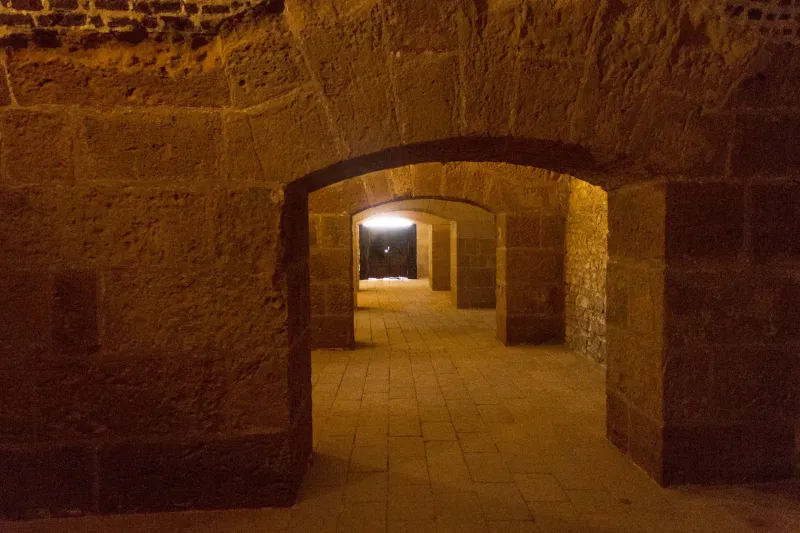
The physical design of Eastern European fortress libraries was itself a form of argument about the permanence of learning. Stone construction, interior placement within fortified compounds, and the deliberate separation of reading rooms from storage vaults all reflected an institutional philosophy in which durability was a primary architectural value rather than an afterthought.
At several sites in what is now western Ukraine and Belarus, archaeological and documentary evidence points to subterranean or semi-subterranean storage chambers specifically designed to protect manuscripts from fire—the most common cause of catastrophic collection loss in the medieval period. These were not improvised solutions. They reflect sustained institutional investment in the physical conditions of preservation at a time when such investment required significant resources and long-term planning.
American research universities have, in recent decades, made considerable investments in climate-controlled rare book facilities and fire-suppression systems. But the fortress library tradition points to something beyond technical infrastructure: a foundational institutional commitment to the idea that the collection must outlast the institution itself. That is a subtly but importantly different orientation than the one that governs most contemporary library planning, which tends to assume institutional continuity as a baseline condition.
What Collapse Teaches
Perhaps the most counterintuitive lesson of the Eastern European fortress library tradition is what it reveals about the relationship between institutional fragility and intellectual resilience. These knowledge systems did not flourish because their parent institutions were stable. In many cases, they flourished precisely because those institutions anticipated instability and designed accordingly.
The Kyiv-Mohyla Collegium, founded in 1632 under Metropolitan Petro Mohyla, operated in a political environment of near-constant pressure from Polish ecclesiastical authorities, Cossack military upheaval, and the looming expansion of Muscovite influence. Its library and curriculum nevertheless produced generations of scholars whose influence extended well beyond the institution's geographic and temporal boundaries. The academy's intellectual output survived the eventual suppression of its institutional form because the knowledge it generated had been embedded in networks, texts, and trained minds that extended far beyond any single building or administrative structure.
This is the principle that American universities and digital archives might most usefully internalize. Collections that exist only within a single institutional framework—whether physical or digital—are vulnerable to that framework's disruption. Collections whose contents, methods, and organizational logic have been distributed across multiple communities, formats, and custodial relationships are considerably harder to erase.
Applying the Principle Today
The practical implications for contemporary American institutions are neither abstract nor particularly difficult to articulate, even if they are demanding to implement. Distributed custody agreements between research libraries, open-access digitization programs that place collection surrogates in multiple independent repositories, and the deliberate cultivation of scholarly communities with deep familiarity with specific collections all represent modern expressions of the fortress library's core logic.
What is harder to replicate is the underlying institutional culture—the conviction, embedded in the daily practice of these Eastern European knowledge centers, that preservation was not a technical function but a moral one. The scribes and librarians who maintained these collections under conditions of genuine political danger did not think of themselves as administrators managing assets. They understood themselves as custodians of something that mattered beyond any particular political moment.
That orientation, more than any specific technique or technology, may be the most durable inheritance the fortress library tradition has to offer American scholarship. In an era of shrinking library budgets, shifting institutional priorities, and accelerating digital obsolescence, it is worth asking whether our own knowledge systems are built to outlast the conditions that created them—or merely to function within them.