Before the Algorithm: How Eastern European Librarians Quietly Engineered the Logic of Modern Information
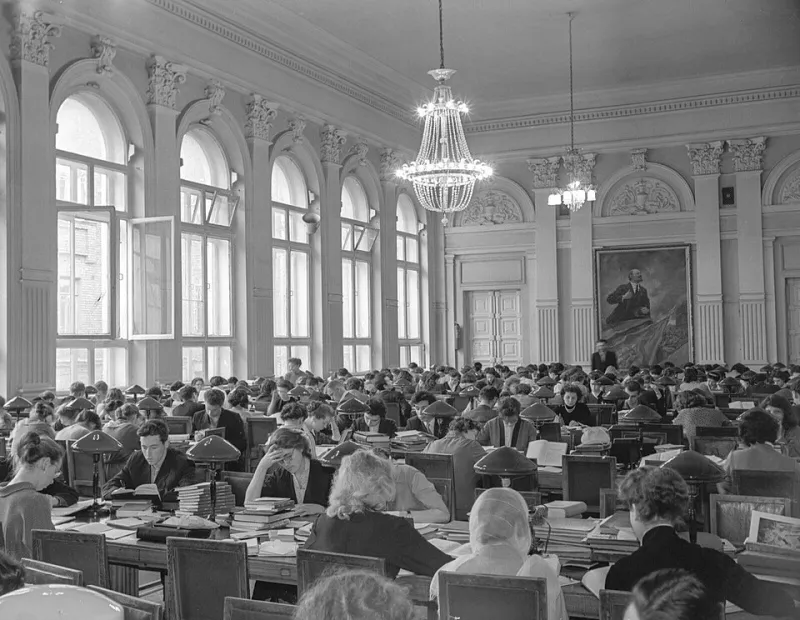
Photo: Главархив Москвы, CC BY 4.0, via Wikimedia Commons
When American technologists speak of organizing the world's information, the conversation tends to begin in California, perhaps with a nod to Vannevar Bush's 1945 essay imagining the Memex, or to the card catalogs of the Library of Congress. What rarely enters the frame is a parallel tradition—methodical, rigorous, and strikingly prescient—that took shape in Warsaw, Prague, Kyiv, and Lviv across much of the twentieth century. Eastern European library scientists, working under conditions of political restriction and material scarcity, engineered solutions to information problems that the digital age would later rediscover and rebrand as its own.
The omission is not accidental. Cold War divisions severed professional networks, language barriers limited the circulation of scholarship, and Western institutions rarely looked eastward for intellectual precedent. Yet the record, now increasingly accessible through digitization initiatives and cross-border archival partnerships, reveals a tradition of information science that deserves far more than a footnote in the discipline's official history.
The Problem of Scale, Solved Under Pressure
The librarians and archivists of interwar Poland offer a useful starting point. Facing the enormous task of reconstructing national collections after the devastation of the First World War and the subsequent conflicts that reshaped Central and Eastern Europe's borders, Polish bibliographers confronted a problem of scale that few Western institutions had yet encountered: how to integrate vast, heterogeneous collections—gathered from multiple empires, written in multiple scripts, organized under multiple prior systems—into a coherent, navigable whole.
Szkolenie bibliotekarzy, the formal training of librarians in Poland during the 1920s and 1930s, produced practitioners who were less concerned with replicating Western models than with solving immediate organizational problems from first principles. The resulting methodologies emphasized flexible categorization, cross-referential indexing, and what later scholars would recognize as a form of faceted classification—the idea that a document could be simultaneously organized along multiple descriptive axes rather than assigned to a single rigid hierarchy. This approach, independently theorized by the Indian bibliographer S. R. Ranganathan around the same period, found parallel expression in Eastern European library science with little mutual awareness between the two traditions.
Soviet-Era Innovation in the Shadow of Ideology
The postwar Soviet period presents a more complicated picture. State control of information was, in one sense, the defining feature of library science across the Eastern Bloc—collections were curated, access was restricted, and cataloging decisions carried ideological weight. Yet within those constraints, Soviet and satellite-state librarians developed organizational systems of considerable sophistication.
The Universal Decimal Classification, originally a Belgian invention, was adopted and substantially elaborated by Soviet library scientists who extended its logical structure and adapted it to accommodate the vast scientific and technical literature being produced by state research institutions. The bibliographic standards that emerged from this work—particularly in the fields of scientific and technical documentation—were, in several respects, more granular and more systematically interoperable than their Western counterparts. Researchers who have examined Soviet-era cataloging manuals from institutions such as the All-Union Institute of Scientific and Technical Information (VINITI) in Moscow describe systems that bear a striking resemblance to the metadata schemas later developed for digital repositories in the 1990s and 2000s.
Czechoslovak library science produced its own strand of innovation. Scholars at Charles University in Prague developed theoretical frameworks for information retrieval during the 1960s that engaged directly with early computational concepts, anticipating questions about relevance ranking and query disambiguation that would not enter mainstream Western information science until the advent of internet search engines. This work was largely invisible to American researchers at the time, published in Czech and Slovak journals with negligible international distribution.
The Ukrainian Tradition: Bibliography as Preservation
In Ukraine, the history of library science is inseparable from the history of cultural survival. The bibliographic tradition centered in Lviv—a city whose intellectual life has been shaped by Polish, Austro-Hungarian, Soviet, and Ukrainian influences in successive and often violent alternation—developed an approach to cataloging that was simultaneously scholarly and preservationist in motivation.
Ukrainian bibliographers of the early twentieth century, many affiliated with the Shevchenko Scientific Society, understood that to catalog a text was, in a meaningful sense, to assert its existence against the forces that sought to suppress or erase it. The meticulous descriptive standards they applied to Ukrainian-language materials—standards that accounted for variant orthographies, multiple editions, and the complex provenance of texts circulating across imperial borders—produced bibliographic records of unusual depth and precision. Contemporary digital humanities scholars working with Ukrainian historical collections have noted that these records often provide richer contextual metadata than anything produced by better-resourced Western institutions of the same era.
Lessons for the Age of Artificial Intelligence
The relevance of this history to present-day debates is neither incidental nor merely honorific. As American universities, technology companies, and federal agencies invest heavily in AI-driven systems for knowledge organization and retrieval, the field is confronting a set of problems that Eastern European library scientists spent decades wrestling with: How should a classification system accommodate materials that resist singular categorization? How can bibliographic standards be designed to remain legible across linguistic and cultural contexts? What is lost when organizational logic is imposed from a single institutional or ideological center?
The answers proposed by mid-century Eastern European practitioners—flexibility over rigidity, multi-axis description over hierarchical assignment, contextual metadata over bare identification—align closely with the principles that information architects are now advocating for AI training datasets and digital knowledge graphs. The convergence is not coincidental. It reflects the fact that the underlying problems of information organization are structural rather than technological, and that generations of practitioners working under constraint often arrive at more durable solutions than those with abundant resources and unquestioned assumptions.
Several American research institutions have begun to take this history seriously. The Library of Congress has expanded its cooperative cataloging partnerships with Eastern European national libraries, in part to incorporate descriptive standards that Western systems have historically underrepresented. Digital humanities programs at universities including Columbia, Michigan, and the University of Illinois at Urbana-Champaign have launched projects examining Eastern European archival methodologies as models for metadata design in multilingual digital collections.
Recovering a Suppressed Genealogy
What is required now is not merely acknowledgment but genuine integration—the incorporation of Eastern European library science into the standard intellectual genealogy of the field. American information science curricula, which typically trace the discipline's origins through a narrow Anglo-American lineage, would benefit from the corrective that this history provides. The alchemists of information who labored in Warsaw reading rooms, Prague university libraries, and Kyiv archival institutes were not peripheral figures working at a remove from the discipline's real development. They were, in many cases, ahead of it.
Recovering their contributions is a scholarly obligation, but it is also a practical one. As the field confronts the organizational challenges posed by exponentially expanding digital collections and the interpretive demands of artificial intelligence, the Eastern European tradition offers not nostalgia but usable precedent. The logic they built, under conditions that would have paralyzed lesser institutions, remains structurally sound. It is time for the broader discipline to learn from it.